Image


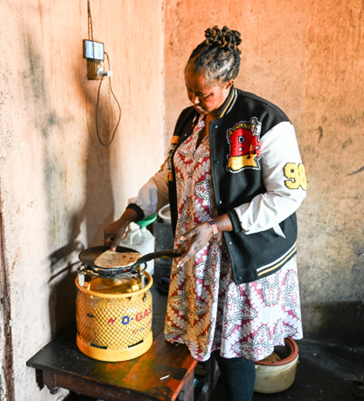
In the early morning hours, the Ikungi market in Singida buzzes with activity. Traders ready their stalls, and early customers arrive to bargain for produce, with others stopping by for a quick breakfast before heading to work. By 7 a.m., Neema Mnyara’s food stall is already in full swing, where she kneads and rolls out dough, expertly preparing chapati (flatbreads) that she sells hot off the stove throughout the day.
For years, Neema prepared her chapatis over a charcoal stove - the most affordable option available to her, though physically demanding, time-consuming, and harmful to her health. Keeping the fire steady required constant attention, adding charcoal, fanning the flames, and adjusting pots over uneven heat. All of that changed in 2024, when she received a free gas canister and burner.
“My staff and I would struggle to breathe in the kitchen because of the smoke from the charcoal stove, and it would also take longer to cook, so I wasn’t able to make enough to meet the demand. Now, if a customer comes, I can serve them faster,” says Neema.
The gas burner Neema received was part of a clean cooking initiative under the JP RWEE. Through the programme, UN Women and partners are working alongside the Government of Tanzania to expand access to clean cooking solutions for women in Singida, Dodoma, and Zanzibar. Beyond supporting national clean cooking commitments and improving health outcomes, the initiative aims to reduce the time women spend on cooking and other unpaid care and domestic responsibilities, allowing them to focus more on income-generating activities.
Thus far, 461 women have received clean cooking stoves through JP RWEE, as well as comprehensive training sessions to support them with the skills to become community ambassadors and advocates for clean energy solutions.
Eight months after Neema started using the gas burner, she has seen her business profits increase.
“I used to spend about Tsh 3000 (approx. 1.5 USD) per day to buy 20kg of charcoal for the restaurant. Now it only costs me Tsh 6000 (approx. 3 USD) per month to refill the canister. With the faster cooking time, I am also able to make more chapatis, selling five times the amount I used to per day.”
Further east, on the island of Zanzibar, women are also reaping the benefits of liquefied petroleum gas (LPG) canisters through a collaboration between the JP RWEE and a private sector partner, Oryx Energies, where the canisters are distributed at a subsidized cost.
Fatma Hassan, a seaweed farmer from central Zanzibar, used to spend three to four hours collecting firewood just to prepare meals. When her health declined, she had no choice but to start buying firewood, adding financial strain on her household income.
“This gas canister really helped,” Fatma said after receiving her burner. “It’s cheaper in the long term, I can cook faster, and now I can use the money I save to buy food and other household needs.”
These stories illustrate how access to clean energy has far-reaching benefits for women, serving as a pathway to economic resilience and an enhanced quality of life.
“Care work is the backbone of our economies, yet it remains undervalued and invisible,” said Lilian Mwamdanga, Programme Specialist at UN Women Tanzania. “By providing women with something as simple as a fuel-efficient stove, we’re not only helping reduce their care responsibilities, we’re enabling them to invest in their wellbeing and participate more fully in the economy.”
Beyond clean energy, JP RWEE is addressing unpaid care work through additional interventions, including the establishment of three childcare centres, with two in Zanzibar and one in Singida, aiming to free women’s time to engage in economic opportunities. Complementary training on positive masculinity is also shifting traditional gender norms by encouraging men to take on a more equitable share of household and economic responsibilities.
Through its holistic approach spanning social, economic, and political empowerment, the JP RWEE is working to eliminate the systemic barriers that limit rural women’s full participation in the economy. By supporting women in harnessing their potential, the project positions them as key drivers of economic, environmental, and social transformation.
JP RWEE’s work supports the Government of Tanzania’s National Clean Cooking Strategy (2024-2034) which aims to transition 80% of Tanzanians to clean cooking solutions by 2034.