Image


In the small farming village of Chinnamasta Rural Municipality in Saptari district, Jaso Kumari Mahato had long toiled on her family’s modest plot of land. Her days began at sunrise and ended well after dark. Yet, despite her tireless efforts, her returns from the market were often disappointing. Though her vegetables were fresh and healthy, they fetched low prices — not because of quality, but because she was selling when the markets were already flooded with produce.
This challenge is common among smallholder farmers, especially those growing summer crops like cucumbers, bitter gourds, and sponge gourds. Prices for these crops peak in March, sometimes reaching Rs 200 (approx. 1.43 USD) per kg, then steadily fall to below Rs 30 (approx. 0.21 USD) by June. However, due to climatic limitations, most smallholders harvest during the low-price period of May and June — leading to reduced earnings.
That changed for Jaso in January 2025. Jaso participated in the training on “Production Plan Aligned with Market and School Demand”, organized under the JP RWEE. The training introduced a game-changing concept: market-aligned production planning. Alongside Jaso, the project trained 119 farmers across 5 local governments as champion farmers to mentor and train their peers.
Instead of following the traditional crop calendar, the farmers learned to analyze seasonal market trends. Trainers presented vegetable price charts for crops like cucumber, bitter gourd, and sponge gourd, showing that prices peak from March to mid-April — when supply is low, and demand is high.
“I always thought growing was enough,” Jaso said. “But I learned that when you grow matters just as much as what you grow.”
Motivated by this insight, Jaso and her group established early nurseries using hot seed beds, trays, and cocopeat provided by the project. They protected the seedlings with plastic tunnels, creating a warm microclimate ideal for winter germination, a low-cost climate-smart technique rarely practiced before in her village. Followed by the training, Jaso received vegetable seed and onsite training on cultivation practices, staking, three G cutting, integrated pest management, mulching and post-harvest management.
By early April, Jaso’s vegetables were ready nearly three weeks earlier than most farmers. When she brought them to the market, customers immediately took notice. Her vegetables were fresher, earlier, and in high demand.
“Last year, I sold cucumbers at Rs 60 (approx. 0.43 USD) per kilo for the first harvest,” she shared. “This year, I received Rs 100 (approx. 0.70 USD) per kilo a significant increase and selling was easy since very few farmers had produced ready at that time.”
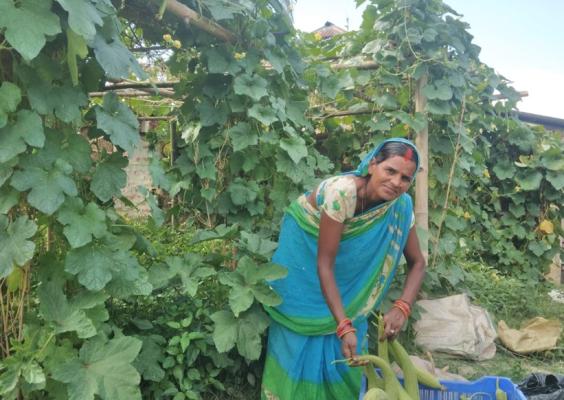
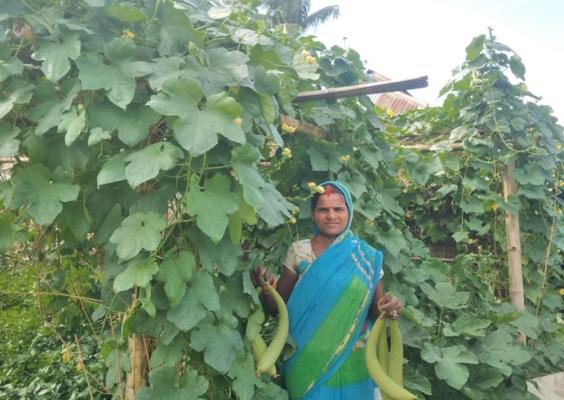
Jabo Devi with her harvest
Jaso’s income increased by 40% not from more land or labor, but by timing her production with peak prices.
Jaso wasn’t alone. Over 475 women farmers across Siraha and Saptari districts replicated this strategy. Inspired by the training, they adopted early nursery establishment, tracked market prices, and aligned their harvests with seasonal demand windows — transforming how they farmed and sold their produce.
To ensure sustained and stable markets, these women’s groups were linked with community schools through the Home-Grown School Feeding (HGSF) programme. This provided a reliable market for surplus produce, with pre-defined crop demands, guaranteed pricing, and regular supply chains. The HGSF model minimized risks, reduced spoilage, and improved income stability — especially for smallholder women farmers.
To reinforce this shift to market-smart agriculture, the project also organized Interaction Workshops with Value Chain Actors across the project municipalities. These events brought together women producers, traders, input suppliers, school representatives, and local officials. The workshops helped bridge gaps between producers and buyers, identify marketing bottlenecks, and build direct business relationships. They concluded with a joint action plan to strengthen market linkages and improve farmer access to better prices.
Meanwhile, the project continued to build farmers’ resilience through training on climate-smart techniques like composting, integrated pest management, mulching, soil health restoration, urine collection, and wastewater reuse. A dedicated WhatsApp group was launched to provide real-time advisory support, and farmers were also linked to the Digital Agriculture Market Price Information System via mobile apps — giving them timely market data to inform decisions.
Today, Jaso is a respected leader among farmers in her community. She has adopted a market-based production calendar for all year round, helps other women schedule nursery preparation, and checks market trends online to guide planting and harvesting decisions.