Image


In Chhinnamasta Rural Municipality of Saptari District, Sarita Mahato, a member of the Ramjanki Farmer Group from Chhinnamasta Rural Municipality – 5, is challenging traditional gender norms and redefining what it means to be a woman farmer. She has transformed her role from supporting her household to becoming a skilled farmer, entrepreneur and community role model.
Like many rural families in Nepal, Sarita’s household faced economic uncertainty. Her husband, Birendra Mahato, earns an irregular income as a construction laborer, while the family of five relies heavily on agriculture for food security and income. Despite owning just 3 kathha (0.024 ha) of land, Sarita was determined to improve her family’s livelihood. She leased an additional 10 kathha (0.08 ha) of land, where she cultivated wheat and established a demonstration plot with five varieties of summer vegetables. Her vegetable production recently generated around NPR 6,000, contributing to household expenses and strengthening her role in deciding on family expenses.
Across Nepal, male outmigration has left women carrying much of the responsibility for agricultural production. Yet increased workloads have not always been matched by access to modern technology, technical skills or decision-making power.
To bridge this gap, the Joint Programme on Accelerating Progress Towards Rural Women's Economic Empowerment (JP RWEE)—implemented by FAO, IFAD, UN Women, WFP and local partners—is working to secure rural women’s livelihoods, rights, and resilience against climate and economic shocks.
Under the programme, partners have established gender-responsive Custom Hiring Service Centers (CHSC) designed to provide women’s groups with access to agricultural machinery alongside training, mentoring and technical support.
Through the CHSC initiative, Sarita’s farmer group received a mechanical ripper, accompanied by practical training and field demonstrations. More than simply introducing new technology, the initiative helped build women’s confidence, leadership skills and capacity to manage agricultural enterprises collectively.
“I never imagined I would operate a machine like this myself”, Sarita recalls. “It was always considered men’s work.” With structured training and subsequent support, she steadily gained the confidence and skill to use the ripper.
This brought a meaningful shift in local gender norms. Breaking long-standing social expectation, Sarita independently used the ripper to harvest wheat on her 10 kattha of leased land, reducing the physical burden of manual labour, saving time and lowering production costs.
More importantly, achievement sent a powerful message throughout the community: when women have access to technology and skills, they can perform mechanized agricultural work just as effectively as men.
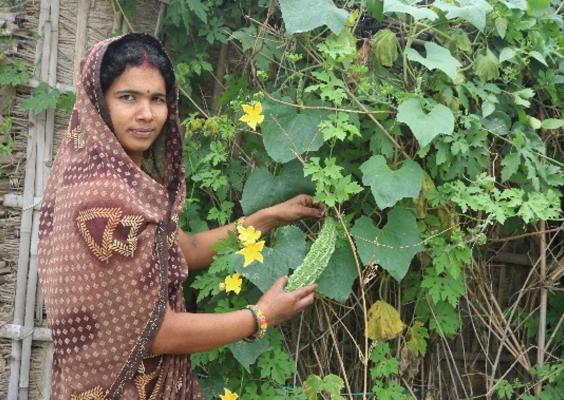
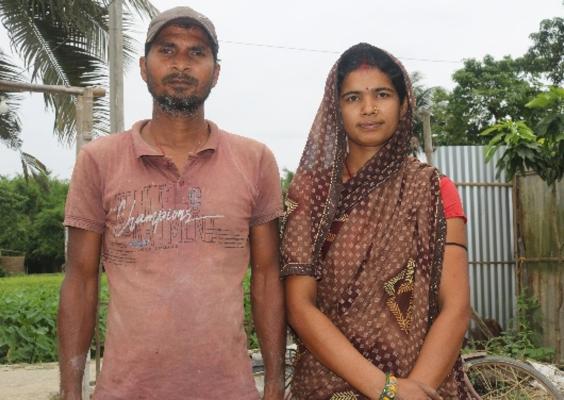
Sarita in the garden. Sarita with her husband Birendra Mahato. Photos: JP RWEE/Nepal
Today, Sarita stands as confident, skilled, and economically empowered women farmer who is actively reshaping gender norms in agriculture. Through the CHSC platform, she has begun offering mechanization services to other farmers, creating an additional source of income while inspiring other women to explore non-traditional roles in agriculture.
Her journey illustrates JP RWEE’s gender-transformative approach under CHSC, where access to appropriate technology is combined with capacity development and institutional support to shift power relations, expand women’s economic agency and promote inclusive rural transformation.
By enabling women like Sarita to step into non-traditional roles, the CHSC initiative is not only improving farm-level productivity but also driving lasting social change — one machine, one woman, and one community at a time.